Be the Sun:
Lessons from the Isis-Osiris-Nephthys Love Triangle
If your eyes are tired, scroll down for an embedded audio of the essay or listen on Spotify or Apple Podcasts.
The Main Lesson
Be the sun. Be stacked. Be Real.
The Method
Speak and act what you think, feel, desire, and know. This is often called “alignment” or what I prefer to call “the stack.” To be stacked is to integrate yourself into wholeness, that is, to re-member yourself out of dis-memberment.[1] To be thus stacked—using discernment, for one must be courageous but not foolish—is to begin to radiate as a sun. Actions and creations become expressions of this central sun, rather than scripted roles we perform from mismatched words and deeds.
[1] I am aware of the slang meaning of stacked and I enjoy adopting this term instead of “alignment,” which, though accurate, has been so overused that it ceases to be helpful.
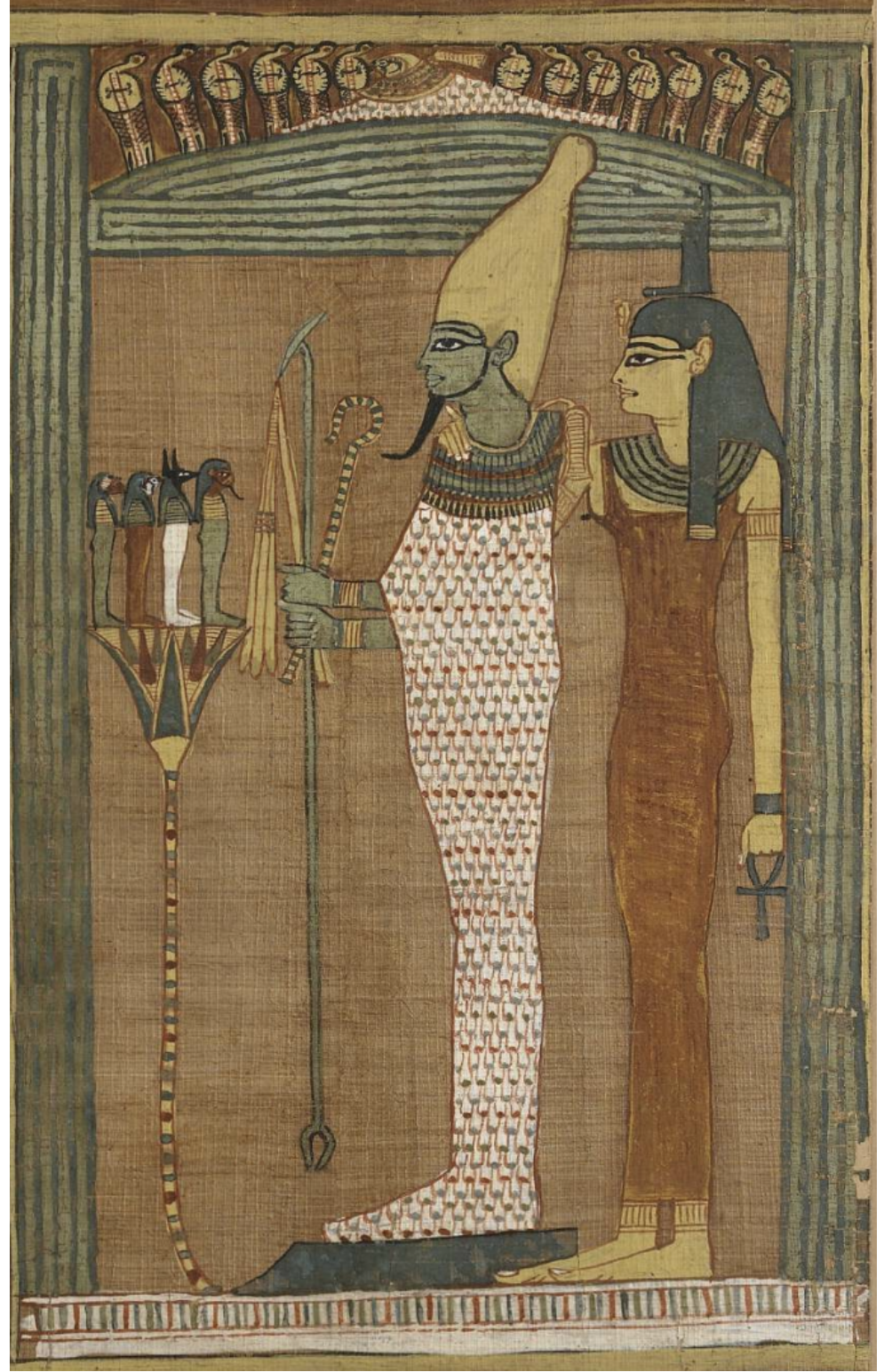
Image above: Osiris and Isis depicted within the Papyrus of Ani, New Kingdom, 19th Dynasty, c. 1250 B.C.
The Drama
Isis (Aset) and Nephthys (Neb-Het) are sisters. Osiris (Ausar) and Isis are a couple and Nephthys and Set (Seth) are a couple.[1] Unlike Isis, who is a solar goddess or one-who-radiates-from-her-wholeness, Nephthys presides over the nighttime and the moon. Osiris has an affair with Nephthys and though I cannot prove this, he was definitely in the doghouse. Set, who had taken over the underworld, murders and dismembers Osiris. (Many confuse “the underworld” (Duat) of this myth with what is called the Lower World in shamanic parlance. But the underworld is the mirror-maze that comprises reality right here and now when driven by fear, scarcity, and illusion. I will write more on Set, the underworld, and how they relate to the human nervous system in a future writing.) Grieving, Isis gathers Osiris’s parts and, helped by Nephthys (eyeroll), puts him back together. Re-membered into wholeness, Osiris is resurrected.
The Drama with Its Lessons
To me, this myth is about the sun and the moon. The sun, as a life-begetting force is the Real and a direct manifestation of the All in undiluted form. In the myth, the sun is represented especially by Isis, but also by post-resurrection Osiris. The moon, as a shiny but cold object, reflects the sun or the Real. It represents the unreal, false gods, illusion, and all that shines from borrowed light.
In its proper function, the moon serves as a reminder of the Real, so that those who cannot yet embody the Real or the sun, can at least remember that it exists through its reflection. The moon is meant to be a mnemonic device.
The problem is that, in an underworld overtaken by Set, most believe that the reflection is the Real; if one lives in the dark night, one may come to believe that the object that lights one’s path is the only source of light.[2] Set, of course, benefits from this, and so does Nephthys. If Nephthys can reflect the sun’s—and her sister’s---innate, life-giving light, she can delay growing her own inner sun. Her affair with Osiris, who has a direct tap to both his own and Isis’s inner sun—as they are connected in love—helps her in this task.
Osiris is torn apart because he is tempted by illusion and by his indecision to commit to Isis, the embodiment of the sun in woman form and, so distracted, he rejects his own inner sun and wholeness.
In my update, it is not that Nephthys and Isis reconcile as sisters to put Osiris back together, it is that Isis re-members herself and integrates Nephthys. Isis realizes: “Nephthys is not real; she is the parts of myself that I ejected. I mistakenly believed that I was too lofty to enjoy carnal beauty and sexual desire. Nephthys is not my sister, she is me. And now, I bring her back into myself, re-membering myself more fully.” When Isis remembers, the projection in the form of Nephthys collapses. Thus integrated, Isis then helps Osiris to re-member himself.
When Isis re-members Osiris and Osiris is thus reborn into his own wholeness, he becomes “Lord of the Underworld,” not because he becomes one with it, but because he has mastered it. He can be among it, without confusing its illusory state for the Real. He can then properly perform his function to guide people through the transition out of this “underworld” of illusion—during a lifetime or between lifetimes.
Though I’m being particularly critical of Osiris, the truth is that he, alongside Isis, are models for how even the supposed gods continue to evolve into increasing wholeness.
[1] The names in the parentheses are closer to the original Ancient Egyptian names. I use the Greek ones not out of preference, but because their familiarity within the modern mind helps the reader focus on the actual lessons of this essay.
[2] In this sense, the underworld is also Plato’s cave with its shadows and illusions. The one who clambers out to the blinding sun and returns to tell the prisoners of the true source of warmth and light is akin to Osiris.
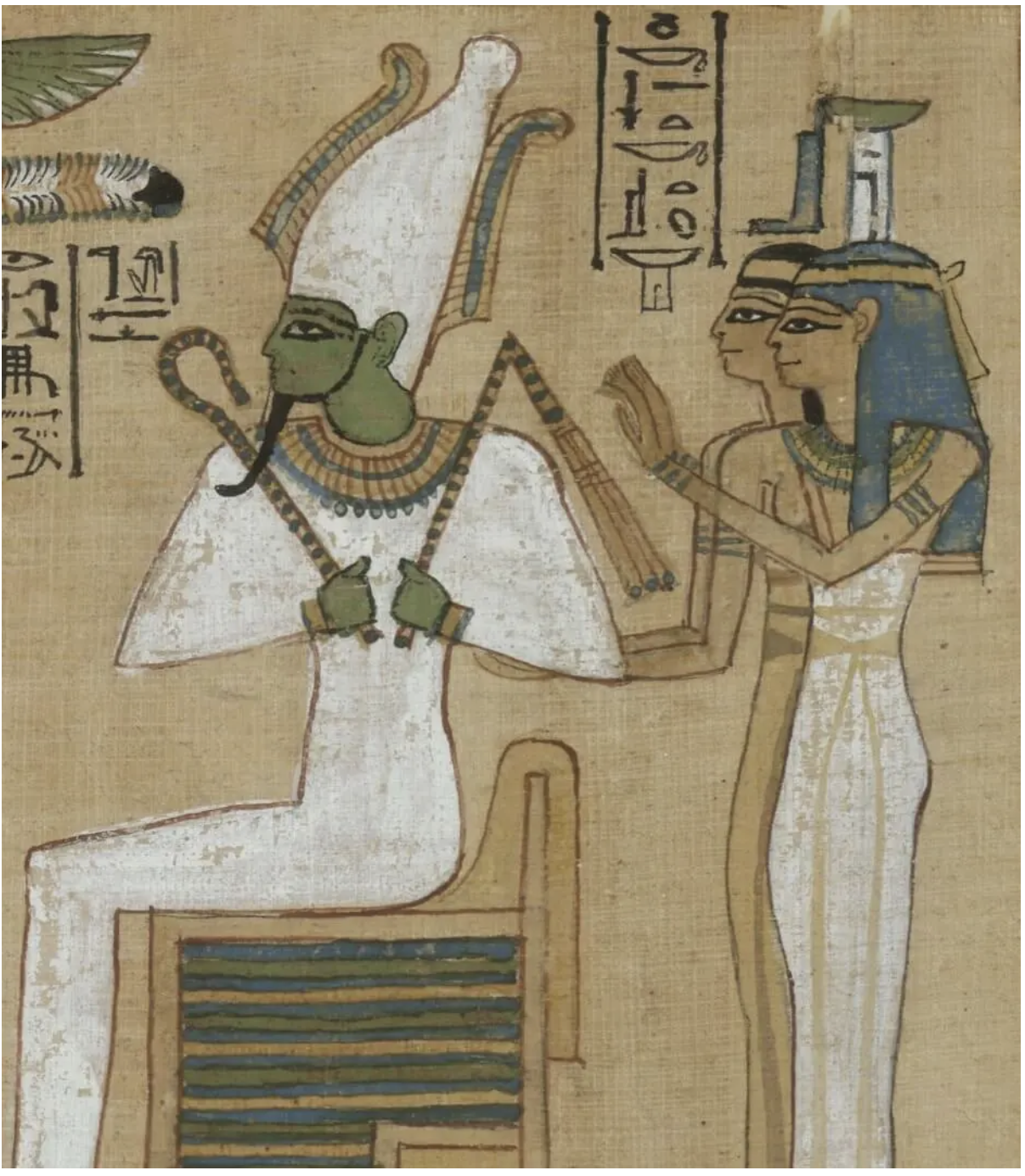
Image above: Osiris with Isis and Nephthys, The Book of the Dead of the scribe Hunefer, New Kingdom, 19th Dynasty, c. 1300 B.C.

Fun Extra
A slice of the Isis and Nephthys myth lives in the 1980s cartoon series Jem and the Holograms. With the help of a computer, Jerrica Benton creates a hologram of herself named Jem and starts a band. At one point, a confused (very confused) Jerrica becomes distraught that her recent ex, Rio Pacheco, is pursuing Jem. Rio is no Osiris, but Jerrica has forgotten that Jem is the hologram-moon version of herself.
Image above: Jem and Jerrica on Jem and the Holograms.
First uploaded on July 31, 2026.