My Favorite Mystics (So Far), Part 1
If your eyes are tired, scroll down for an embedded audio of the essay or listen on Spotify or Apple Podcasts.
The word “mystic” is an imperfect placeholder for what I truly mean: a person who has stabilized access to perception beyond the five senses and brings the knowledge acquired through this broadened perception into the realm of the five senses. The mystic is akin to a conduit who can receive the information or grace (depending on one’s preferred vocabulary) without becoming destabilized and lives mostly in vertical relation. This is why I use the term “mystic-conduit” in this essay. As such, the mystic-conduit is not an identity so much as a structural function of one who can access the vertical realms above or below—though they may not use these terms—and bring them into the horizontal world.
Nikola Tesla (1856-1943)
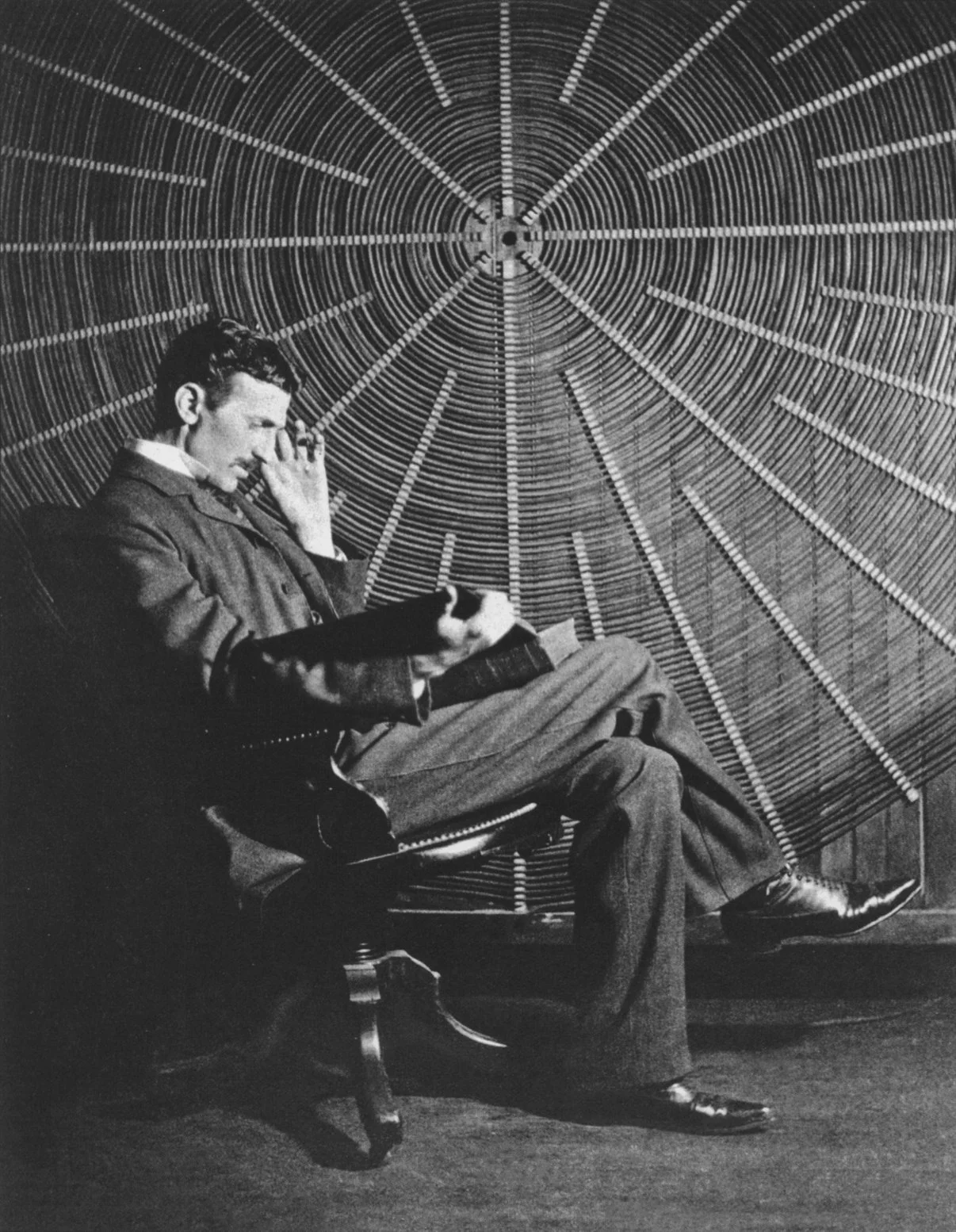
Serbian inventor Nikola Tesla’s legacy expresses perfectly how broader society can sometimes flatten the person who lives vertically, while extracting from them what is immediately useful. While many profited, and continue to profit, from some of his patents, Tesla’s more unconventional ideas and sources of inspiration remain peripheral. But the man who created the profitable patents is the same man who had visions of vibrant lights, spoke about the universe in terms of frequency and light, worked on inventing an apparatus that would help humans communicate with intelligent life on other planets, and had close friendships with pigeons. It is a kind of spiritual vivisection to truncate a whole person to suit the desires of a consuming public, and here I include intellectual consumption.
At times, some of Tesla’s writings have a spiritual or cosmic valence, since science and spirituality meet where awe is the response to the forces behind all of reality. “Perhaps,” he writes, “if we could clearly perceive all the intricate mechanism of the glorious spectacle that is continually unfolding before us, and could, also, trace this desire to its distant origin, we might find it in the sorrowful vibrations of the earth which began when it parted from its celestial parent.”[1] In this poetic language is a cosmic longing that many mystic-conduits express.
The lyricism of the person who uses language as an imperfect vehicle through which the vastness of reality can be expressed to others ties the scientist Tesla with the unabashedly religious Saint Teresa of Avila, the next mystic-conduit.
[1] Tesla, “Talking with the Planets,” Collier’s Weekly, February 9, 1901, pp. 4-5. Accessed from teslauniverse.com on August 20, 2026.
Image: Unknown author - Originally published in "Tesla's Important Advances" in Electrical Review, May 20, 1896, p. 263. Credited in caption to Tonnelé and Co. Accessed from Wikimedia Commons August 20, 2026.
2. Teresa de Avila (1515-1582)
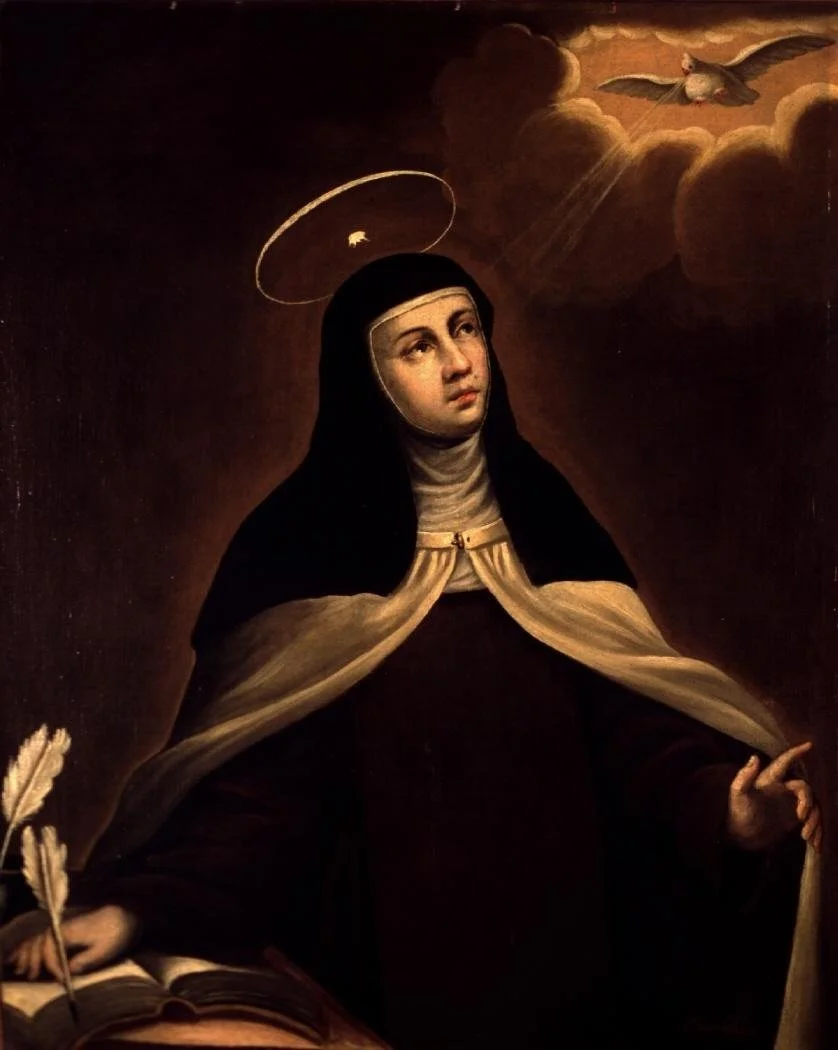
Oh, Teresa, how I love thee. I repeatedly turn to this sixteenth-century Spanish nun because her experiences—the wonder, the intensity, the haughtiness, the fire, the doubts, the disappointments—at times resemble my own. I read her like a sister-mirror who does not always reflect my experiences, in perception or interpretation, but whose writings nevertheless offer company and help refine my own process.
Many encounter Teresa de Avila through a flattened lens of Sexy Sassy Ecstatic, and it is not that she did not have this aspect, it is that to erase the many years she dedicated to finding a logical language for the metamorphosis she underwent required an unglamorous discipline that is less attractive to Instagram or Substack algorithms.
But it is precisely the discipline that I most appreciate about Saint Teresa, which may be helpful for others who face similarly dramatic awakenings and raptures. She emphasizes the crucial importance of stabilizing the expansiveness of intense mystical experiences so that they do not lead to fragmentation or worse.
In relation to what may obscure the soul’s innate radiance, she writes, in Mirabai Starr’s translation: “The fountainhead that shines like the sun from the center of the soul never loses its radiance. It is ever-present within the soul and nothing can ever diminish its beauty. But obviously, if we were to drape a black cloth over a crystal sitting in the sunshine, no matter how brightly the sun shines it will have no effect on the shrouded jewel.”[1] Though she uses the word “evil” to help describe this cloth, we don’t have adopt that term to find her warning against all that could obscure the soul’s radiance salient to our daily lives. And the greatest evil to Teresa de Avila is materialism.
Many assume that “materialism” refers to superficiality and desiring wealth and fancy objects. This is certainly how I interpreted this term as it appeared in religious and spiritual literature before my drastic shift in perception. Though that surface definition remains relevant, I now clearly see the deeper layer: the belief that what is real is only that which can be perceived with the five senses, that is, the world of dense matter. Hence, they warn us against the “material world” and its values.
What Teresa de Avila called the evil of the material world is analogous to my next mystic-conduit’s warning against the mechanization of most humans.
[1] St. Teresa de Avila, The Interior Castle (1577), translated by Mirabai Starr (2004), 42.
Image: Santa Teresa de Jesús, Anonymous based on a painting by José de Ribera, c. late 1600s.
First uploaded on August 20, 2026.