My Favorite Mystics (So Far), Part 2
If your eyes are tired, scroll down for an embedded audio of the essay or listen on Spotify or Apple Podcasts.
The word “mystic” is an imperfect placeholder for what I truly mean: a person who has stabilized access to perception beyond the five senses and brings the knowledge acquired through this broadened perception into the realm of the five senses. The mystic is akin to a conduit who can receive the information or grace (depending on one’s preferred vocabulary) without becoming destabilized and lives mostly in vertical relation. This is why I use the term “mystic-conduit” in this essay. As such, the mystic-conduit is not an identity so much as a structural function of one who can access the vertical realms above or below—though they may not use these terms—and bring them into the horizontal world.
3. Georgij Ivanovič Gurdjieff (1866/1877-1949)
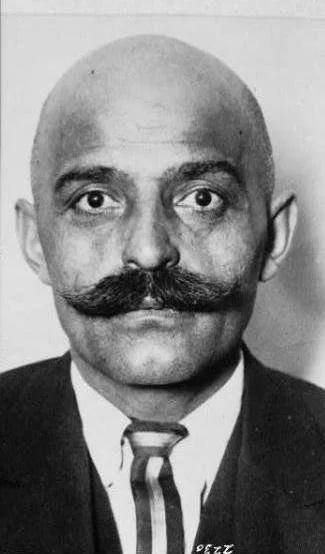
The Armenian-Greek spiritual teacher George Gurdjieff convinced me that the mystic-conduit may reflect something back to a person that they do not want to face.
When I first encountered Gurdjieff’s ideas, through the writings of one of his students, the Russian mathematician Peter Ouspensky, I was both fascinated and enraged. Though my mystical experiences had already begun, I had not matured into the process and a lot remained “triggering.” Gurdjieff purposefully spoke in a way that provided the “shocks,” as he called them, necessary for someone to awake from the sleeping state that he ascribed to most of humanity. To him, most people moved unconsciously, responding to external stimuli, and, as such, were no better than machines who lacked soul. To my knowledge, Gurdjieff did not racialize this concept, but, because that kind of thinking was used to buttress the violent subjugation of entire populations, I projected this layer of meaning onto it.
I can now see his concept for what it is, not for what I projected onto it. But others may remain disgusted with the one who instigated the initial shock. Some may even learn from this shock, but never acknowledge the source of the pivot point. They may even turn to softer, “low-fat” spiritual teachers who may soothe the seeker’s surface ego—that which is not the soul—rather than help break it.
Mystic-conduits often induce these kinds of shocks even without being provocative, but by openly living in their truth, because being in communion with verticality pokes a hole in a purely horizontal perspective of reality—meaning a version of reality in which all that exists is the five-sense world. The conduit must therefore accept that their influence may be much larger than will ever return to them in kind.
Thankfully, I remembered that Gurdjieff provided me with a shock in the sense that I had to distinguish between projection and reality. I offer him gratitude for this. (My own mystical experiences, separate from any teacher or spiritual tradition, had already shown me that consensus reality is a state of sleep, hence the term “spiritual awakening.”) I continue to return to him to find helpful analogies and curious differences between his own cosmology and the one that is unfolding within and from me.
Another aspect I love about Gurdjieff is his perpetual astonishment at varied perception. “The form of the exposition of my thoughts in these writings,” he observes, “could be understood exclusively by those readers who, in one way or another, were already acquainted with the peculiar form of my mentation. But every other reader for whom, strictly speaking, I had goaded myself almost day and night during this time, would understand nearly nothing.”[1] The one who has not had experiences of broadened perception will not understand certain layers of what a mystic-conduit is saying. This is not because the uncomprehending listeners or readers are stupid, but they simply have not experienced the thing. Someone who has never tasted something sweet can hear someone else describe the taste of a sugary cupcake in great detail and never know what sweetness is.
The failure of language in the face of embodied knowing is a constant in the next mystic-conduit’s teachings.
[1] In Life Is Only Real Then, When ‘I Am’ (5).
Image:From the Janet Flanner-Solita Solano papers, c. 1925 and 1935(?). Accessed via Wikimedia Commons Aug. 20, 2026.
4. Aunt Tansia (late 19th-late 20th century)

We meet Aunt Tansia in Mimerose Beaubrun’s luminous book Nan Domi: An Initiate’s Journey into Haitian Vodou (2010).Beaubrun, an anthropology scholar and Vodou initiate, shares her recollections of Aunt Tansia’s teachings in the Ginen branch of Haitian Vodou.
What strikes me about Tansia is that her mastery is such that she can guide others into the subtle realms with surprising precision. At one point, Beaubrun is curious about Tansia’s stones. Tansia allows Beaubrun to hold them and the acolyte is plunged into the realm of the stone. The stone appears to her as a radiant being who speaks with her. In another instance, Tansia deems Beaubrun ready to be guided on her cosmic trip along the Milky Way and Beaubrun has a transcendent experience on this trip.
An aspect of Aunt Tansia’s journey that resembles my own and Teresa de Avila’s is her experience of what some would call divine union happened unexpectedly. Both Tansia and Teresa were 40-something-year-old feminine women busy with the mundane (even Teresa admits this despite her status as a nun), when God or Ginen took them and would not let go.
Much of Tansia’s guidance was practical and grounded, reminding Beaubrun and the reader of the crucial importance of not just opening oneself willy nilly to forces beyond the world of dense matter or the third dimension.
Like Teresa de Avila and Gurdjieff, she also cautioned against the false notion that all that existed was in the realm of matter. “[E]ven when you act externally,” she tells Beaubrun, “that is to say from your physical body, you must retire into the inner part of yourself. Even when, in the eyes of others, you are taking care of worldly affairs, you are no longer of this world. It is extremely urgent that you begin to practice this way of being. Like an actor, play your role in the theater of this world, knowing all the while that the stage is only a place you are passing through and that you must leave when the curtain falls.”[1]
The importance of living as an expression of the inner vastness is the central lesson of my final chosen mystic-conduit: Kiki.
[1] Beaubrun, Nan Domi, 114.
5. Kiki in Hayao Miyazaki’s Kiki’s Delivery Service (1989)
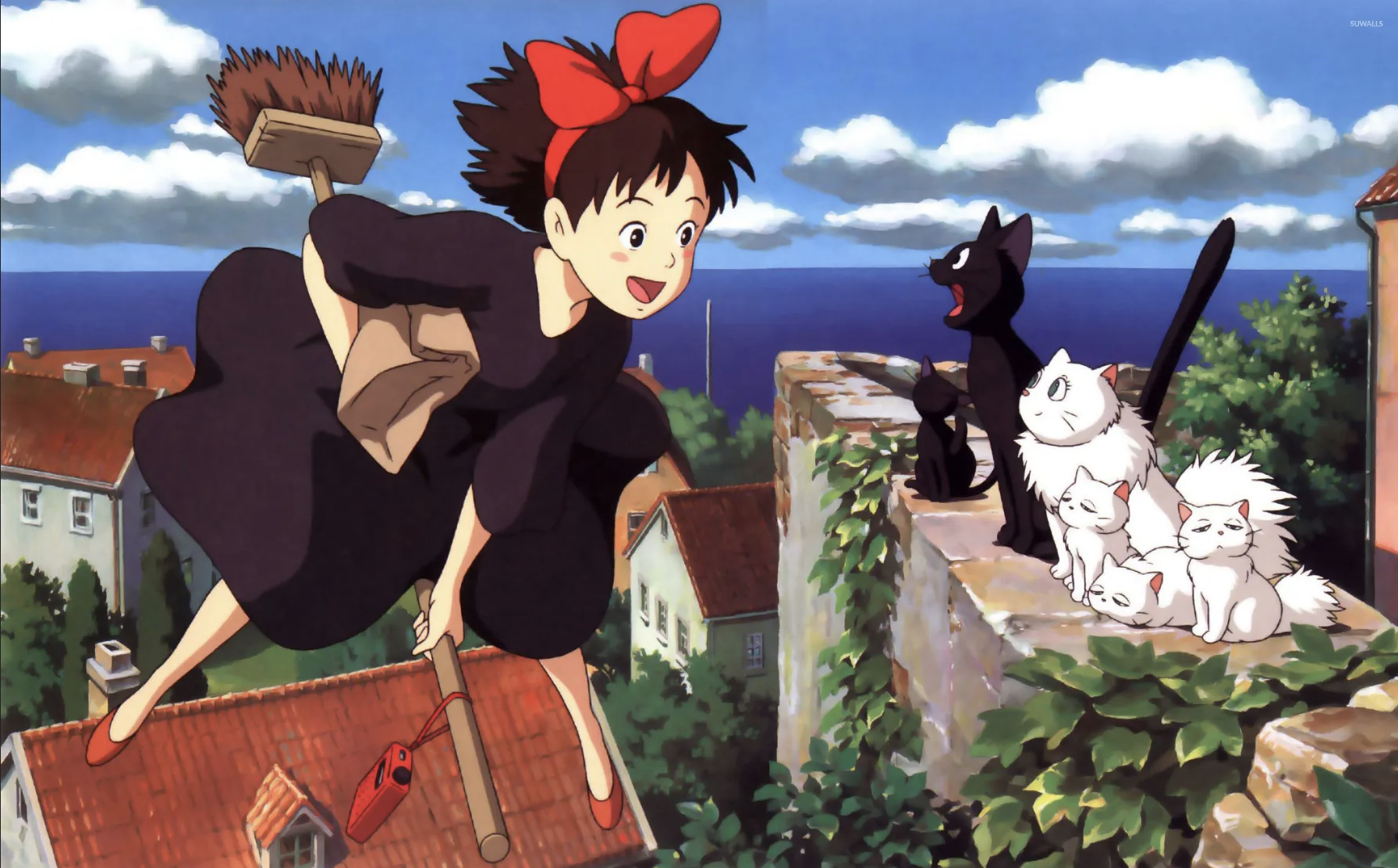
On a full moon night, 13-year-old Kiki and her feline friend Jiji fly out of her bucolic village on a broom, landing on a buzzing, sea-side city of redheads. Though some are momentarily awed, the distracted crowd is mostly annoyed and befuddled when Kiki introduces herself and offers her witch services.[1] This gap between her home village’s appreciation for the “resident witch,” her mother, and this town’s seeming indifference fuels homesickness, but she soon finds a supportive friend in an extremely pregnant baker and a niche as a delivery girl. While not the most glamorous way to use her powers, Kiki finds pride and joy in helping others.
The film showcases several lessons that Kiki must learn. The first one was elucidated above: that random people on the street cannot immediately appreciate something does not mean that no one can appreciate that same something.
The second lesson that Kiki must learn is remember that her gift of flight comes from within, not from external pressures. Besides Tombo, a boy who loves to make flying machines and has a crush on her, other teens tease or ostracize her. Because she cannot afford the trendy clothing that she believes will help her fit in, she overworks, gets very sick after an ill-advised broom-flight under a storm, and loses her ability to fly. She confides to Tombo that “flying used to be fun until I started doing it for a living.”
Despairing, she spends a few restorative days in the forest with her artist friend, who gives her wise advice about how creative forces work. “When you fly, you rely on what’s inside of you don’t you?” asks her painter friend. “We fly with our spirit,” Kiki responds. “That same spirit,” continues the painter, “is what makes me paint and makes your friend bake. But we each need to find our own inspiration, Kiki. Sometimes it’s not easy.” Kiki finally regains her power when a catastrophic dirigible accident threatens Tombo’s life and she must remember how to fly to save him.
The third lesson of this film is the way that Kiki finds community without ever flattening herself into someone she is not, tempted as she was. Kiki’s first friends are the boisterous baker and her beefy, nonverbal partner, but she also connects with the aforementioned artist; a local fashion designer; a very genteel elderly woman and her maid; and, of course, Tombo, the boy awed by her ability to fly but who does not feel diminished in his own pursuit of flight via engine. This becomes Kiki’s hodgepodge, multi-generational, and mutually supportive community.
[1] I do not use the term “witch” to describe myself and not all self-denominated witches are mystic-conduits. In this case, because Kiki can fly or levitate from her own inner coherence rather than from “casting spells” or manipulating the elements, I consider her a conduit.
First uploaded on August 20, 2026.